Metrics
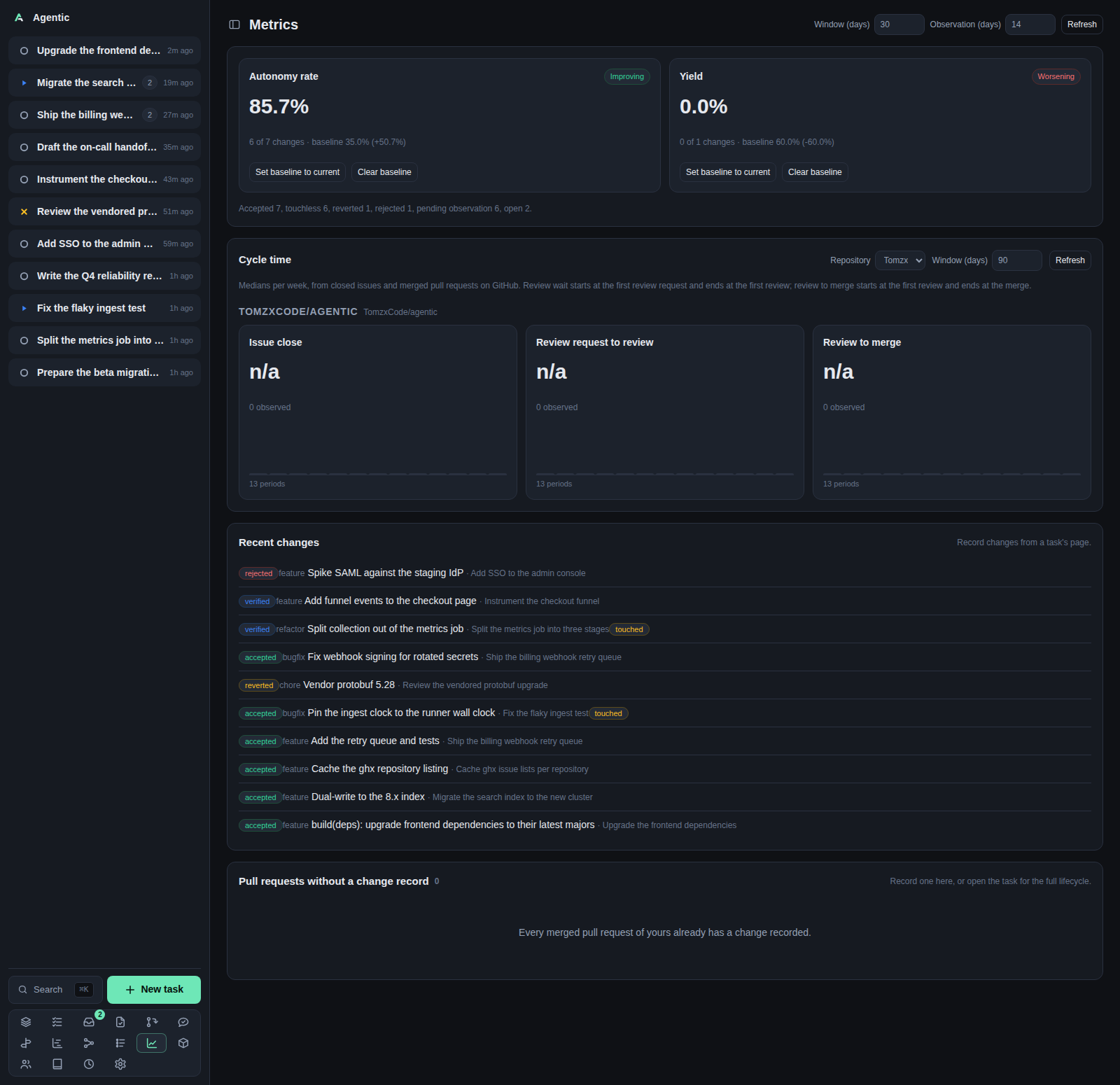
/metrics shows whether the agent is landing work you keep: autonomy rate, yield, and the cycle times behind them.
Problem
"It feels faster" is not a measurement. This page answers two questions with numbers: how much accepted work the agent landed without you touching it (autonomy rate), and how much of it survived its observation window (yield). Both are shown against a baseline you store, so direction is visible, not just the value. A cycle-time section adds where pull requests and issues actually spend their time.
How to use it
The controls
| Control | Default | What it does |
|---|---|---|
Window (days) |
30 | How far back accepted changes are counted. |
Observation (days) |
14 | How long a change must survive before it counts towards yield. |
Refresh |
Reloads the metrics. |
The tolerance for calling a change flat is 0.02 on the server and is not exposed in the UI.
The metric cards
Each card shows the direction (Improving, Worsening, Flat, No baseline, or No data), the value as a percentage, N of M changes, and the baseline with the difference.
| Button | What it does |
|---|---|
Set baseline to current |
Stores the current value as the baseline for that metric, with the window and observation it was measured over. |
Clear baseline |
Removes the stored baseline, so the card reads No baseline. |
Without a baseline, a metric still shows its value and its counts; it just has no direction.
The line under the cards counts accepted, touchless, reverted, rejected, pending-observation, and open changes.
How the numbers are computed
- Autonomy rate is touchless accepted changes divided by accepted changes in the window. A change touched by a human intervention is not touchless.
- Yield is accepted changes not reverted divided by accepted changes whose observation window has elapsed. A change still inside its window is pending and excluded, so a recent change never counts as a survivor by default.
- Direction compares the value to the stored baseline with the flat tolerance.
- Cycle times are medians per weekly bucket, computed per event.
Cycle time
The Cycle time panel has a Repository select, its own Window (days) (90 by default, at most 730), and Refresh.
The select offers All repositories plus every repository with a GitHub remote, your own login first.
The choice is remembered on this device under agentic.metricsRepository.
Each series shows a median and N observed with a bar sparkline:
- Issue close: opening an issue to closing it.
- Review request to review: a pull request's first review request to its first review.
- Review to merge: a pull request's first review to its merge.
The server caches a repository's data for 600 seconds; Refresh bypasses it.
Recent changes and the leftovers
Recent changes lists recorded changes with their status, class, title, task, and a touched badge when a human intervened.
It is unfiltered and unbounded.
Pull requests without a change record N lists merged pull requests you authored, linked to a task, that no change references yet.
Each row has a Record accepted button, which creates the change already accepted and dated to the merge.
A merge the app observes on its own is recorded without this button, so this list is what is left: no GitHub login configured, no stored author, or a merge that happened while nothing was watching.
Good to know
- Every card reads
No baselineuntil you store one; that is not an error. - The cycle-time panel always renders; with no repository that has a GitHub remote it says
No repository has a GitHub remote yet. Every merged pull request of yours already has a change recorded.is the good empty state of the leftovers list.- Nothing polls; the page reloads on mount, on a window change, on
Refresh, and after a baseline or record action.
CLI and agent interface
| Operation | CLI | HTTP |
|---|---|---|
| Read the metrics | agentic metrics show --window-days 30 --observation-days 14 |
GET /api/metrics?window_days=&observation_days= |
| Narrow to one task or class | agentic metrics show --task-id <task> --change-class bugfix |
same query parameters |
| Read cycle time | agentic metrics cycle-time --days 90 --repository <repo> --refresh |
GET /api/metrics/cycle-time?days=&repository_id=&refresh= |
| List baselines | agentic metrics baseline list |
GET /api/metrics/baselines |
| Set a baseline | agentic metrics baseline set autonomy_rate 0.2 |
PUT /api/metrics/baselines/{metric} |
| Clear a baseline | agentic metrics baseline delete autonomy_rate |
DELETE /api/metrics/baselines/{metric} |
| Record a change | agentic change create <task> --title … --change-class … |
POST /api/changes |
| Record a merged pull request as accepted | none | POST /api/changes with status, opened_at, and accepted_at |
agentic metrics baseline set takes the value, --window-days, and --observation-days, so a baseline stored from the CLI carries the same measurement context as one stored from the page.
Record accepted has no CLI equivalent: agentic change create records a change at proposed and cannot set the accepted status or the merge dates.
Related
- How to track changes and read the metrics.
- Inbox for the same merge bookkeeping as a decision.
- Settings for the GitHub login under GitHub.
- Concepts for what a change record holds.